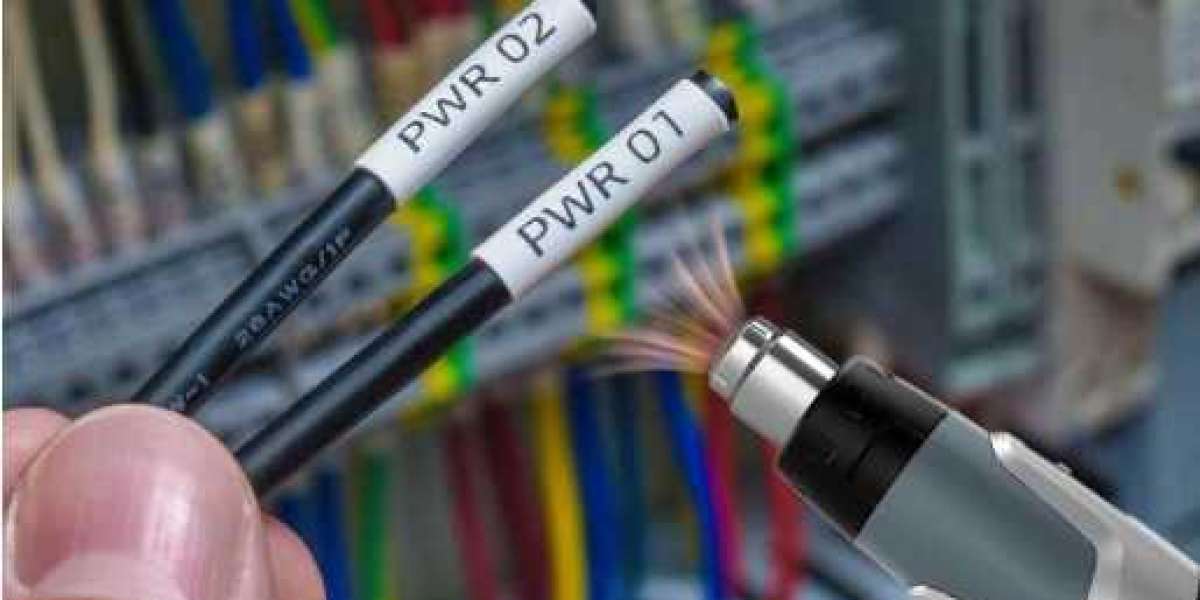

When an industrial automated system grinding to a halt due to a blown internal relay, every minute of unexpected downtime costs thousands of dollars in lost manufacturing throughput. Plant engineers and maintenance technicians face a high-stress scenario, forced to trace a maze of hundreds of identical, tightly packed control wires inside a cramped, high-voltage electrical enclosure. In these critical environments, clear and immediate cable identification changes everything between a five-minute fuse replacement and a catastrophic multi-hour tracking disaster. Navigating complex secondary wiring without reliable, structured identifiers introduces a hidden operational vulnerability that threatens industrial safety, complicates diagnostic speed, and compromises system reliability.
Why Ink and Tape Fail in High-Heat Enclosures
For decades, panel builders and industrial electricians relied on manual, analog methods for circuit tagging, such as wrapping adhesive vinyl tapes or writing directly on cables with permanent markers. However, the internal microclimates of industrial control cabinets present severe environmental challenges that cause these traditional marking methods to fail prematurely.
Industrial enclosures regularly experience high ambient operating temperatures caused by dense component clusters, variable frequency drives (VFDs), and large power transformers. Under prolonged thermal exposure, the pressure-sensitive adhesives used in standard vinyl tapes dry out, crystallize, and lose their bonding integrity. This leads to flagging, where the edges of the label lift, split, and eventually unravel from the wire jacket. Furthermore, fine industrial dust, airborne greases, and cleaning solvents penetrate the exposed adhesive layer, accelerating the degradation process. Handwritten marker text and standard ribbon inks smudge or fade to illegibility under these conditions, turning vital circuit directories into useless, blank markers that delay emergency maintenance and compromise safety.
What Makes an Identification Solution Compliant?
To survive the punishing environments of modern automated factories, a professional wire identification system must move beyond standard office supplies and implement rugged engineering standards. An effective industrial labeling solution must possess distinct material characteristics capable of withstanding physical, chemical, and thermal stressors over a multi-decade operational lifespan.
-Permanent 360-Degree Mechanical Adhesion: Labels must wrap completely around the circumference of the conductor, eliminating any exposed adhesive edges that could pick up dirt or peel away under high friction during heavy wire-pulling.
-High Thermal Tolerance and Fire Retardancy: Marking materials must be engineered to operate continuously at high temperatures (typically ranging up to 125°C) and must comply with industry safety standards like UL 224 for flame resistance.
-Complete Chemical and Solvent Resistance: The printed text must remain highly legible even when exposed to industrial degreasers, hydraulic fluids, lubricating oils, and aggressive cleaning agents.
-Structural Clarity and Data Density: The identification method must support high-resolution printing to cleanly fit multi-level hierarchical data—such as source terminal codes, destination module numbers, and functional tags—onto narrow-gauge wires without smudging.
Choosing the Right Heat Shrink Tubing Sizes
Transitioning your plant infrastructure to a reliable, industrial-grade identification framework requires moving away from surface adhesives and adopting high-performance heat-shrinkable wire sleeves. Figuring out exactly what heat shrink tubing size do I need for my cable requires a methodical approach based on physical measurements and volumetric expansion ratios rather than guesswork.
The Core Metric: Calculating Outside Diameter (OD)
Before selecting your marking materials, you must determine the total outside diameter (OD) of the wire, including its insulation layer. Do not rely solely on the American Wire Gauge (AWG) size of the conductor, as different insulation types (such as THHN, XHHW, or MTW) significantly alter the final thickness of the cable jacket. Use a digital caliper to measure the maximum cross-sectional diameter of the insulated wire.
Navigating the Shrink Ratio Dynamics
Industrial heat shrink labeling materials generally utilize a 2:1 or 3:1 shrink ratio. This ratio defines how much the tubing can compress when heat is applied.
-2:1 Shrink Ratio: Compresses to half its original expanded size.
-3:1 Shrink Ratio: Compresses to one-third of its original expanded size.
For modern high-density electrical cabinets with varying wire thicknesses, a 3:1 shrink ratio is highly recommended. This higher compression range provides greater flexibility, allowing a single size of tubing to fit securely over both slim control wires and thick insulated crimp terminals.
The Selection Rule: Max Expanded vs. Min Recovered
To achieve a tight, permanent, slip-proof fit, your selection must satisfy a simple engineering rule: The tubing's Expanded Inner Diameter (Minimum as supplied) must be large enough to easily slide over the wire and terminal lug, while its Recovered Inner Diameter (Maximum after heating) must be smaller than the wire's total outside diameter.
Wire Gauge Range (AWG) | Typical Insulated Wire OD (mm) | Recommended Tubing Size (Expanded Inch) | Minimum Expanded ID (mm) | Maximum Recovered ID (mm) |
#22 AWG to #16 AWG | 1.6 mm – 3.2 mm | 1/8 inch (3.2 mm) | 3.2 mm | 1.0 mm |
#16 AWG to #10 AWG | 3.0 mm – 5.2 mm | 1/4 inch (6.4 mm) | 6.4 mm | 2.1 mm |
#8 AWG to #4 AWG | 5.5 mm – 8.8 mm | 3/8 inch (9.5 mm) | 9.5 mm | 3.1 mm |
By deploying high-resolution heat shrink cable labels that match these precise dimensions, text remains crisp and undistorted after full recovery, anchoring your identification system permanently to the circuit conductor.