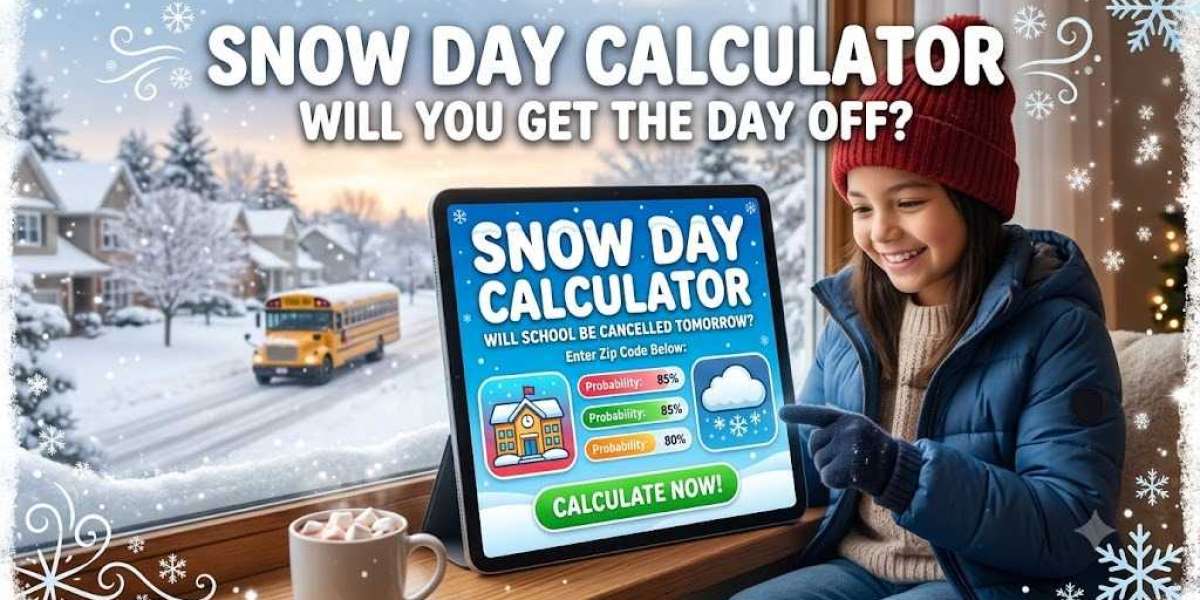

When the temperature drops and the clouds turn gray, a collective question ripples through school districts: "Will there be a snow day tomorrow?" While students cross their fingers, parents turn to the snow day predictor. This powerful tool has evolved from simple observation into a data-driven system. But what is the science behind it, and why does it sometimes get the call right—or wrong?
The Evolution of the Snow Day Predictor
In years past, predicting a school closure was mostly guesswork, relying on local "rules of thumb" or listening to the morning news. Today, a snow day predictor uses sophisticated algorithms to bridge the gap between complex meteorological data and community planning. It doesn't just look at the snow; it analyzes the entire storm profile.
Modern predictors act as a funnel. They take in vast streams of data from the National Weather Service, local radar stations, and historical closure records, and they distill that information into a single, easy-to-understand probability percentage.
Meteorological Factors: The Building Blocks of a Prediction
A snow day predictor isn’t just measuring flakes; it’s evaluating the physical state of the environment. Here are the core data signals that fuel these calculations:
Atmospheric Pressure: Rapidly dropping barometric pressure often signals a strengthening storm. Predictors monitor these trends to see if a storm might intensify faster than initial forecasts suggested.
Precipitation Phase: Is it snow, sleet, or freezing rain? Freezing rain is often more disruptive than snow because it coats roads and power lines in a thin, dangerous layer of ice that is incredibly difficult to treat with salt.
Wind and Visibility: High winds during a storm create "whiteout" conditions. Even if total snowfall is low, a predictor will increase the closure probability if sustained winds threaten the visibility of school bus drivers.
The "Bus Hour" Threshold: Algorithms specifically weight the timing of the storm. Snow that falls at 1:00 PM usually has zero impact on school operations. Snow that peaks between 6:00 AM and 8:00 AM—the time buses are on the road—is the "golden hour" for closures.
How Algorithms Integrate Historical Patterns
Every district has a "signature." A district in a region that sees snow once a year will react very differently than a district that sees it weekly. A smart snow day predictor integrates this historical context.
If a district has a history of closing for two inches of snow, the algorithm will flag a 2-inch forecast as a high-risk event. Conversely, if a district is in the "Snow Belt" and historically stays open for six inches, the algorithm will adjust its threshold, preventing unnecessary panic and keeping predictions realistic.
Case Study: Optimizing Teacher Workflows
Consider Mr. Henderson, a high school teacher in an area prone to erratic winter storms. For years, he struggled with last-minute lesson plan adjustments when schools closed without warning. By using a snow day predictor, he began checking the probability index on Tuesday evenings.
When the predictor showed an 80% chance for Wednesday, he didn't assign an in-class exam. Instead, he posted an online-accessible review module for his students. When the district officially closed on Wednesday morning, the transition to at-home learning was seamless. The predictor allowed him to stay ahead of the disruption, showing how these tools optimize not just parenting, but professional workflows as well.
The Role of AI in Modern Forecasting
We are currently in a "Golden Age" of AI weather forecasting. Modern tools are beginning to use machine learning to recognize patterns that humans might miss. By training on thousands of past storms and corresponding closure decisions, these AI models can learn the specific "sensitivities" of a school district.
However, AI still faces the "chaos factor." Weather forecasting is a calculation of fluid dynamics, and small shifts in temperature—even by a single degree—can change rain to sleet, or snow to sunshine. This is why predictors provide a percentage rather than a binary "yes" or "no." It is an acknowledgment of the inherent uncertainty in the atmosphere.
Conclusion: Balancing Data with Reality
A snow day calculator is a bridge between the complexity of meteorological science and the simplicity of your daily schedule. It provides an educated "second opinion" that helps you prepare. While no tool can account for every administrative decision, understanding the variables behind the probability—timing, temperature, and road safety—allows you to interpret these forecasts with greater accuracy. Use the data, plan ahead, and keep an eye on your local district’s official channels for the final word.
Frequently Asked Questions (FAQs)
Is there a chance of a snow day tomorrow?
If your local forecast predicts heavy snow or ice during peak morning hours, the chance is high. Check your school district's social media and local news channels for the only official closure announcements.
What is the best way to interpret predictor percentages?
Think of percentages as a "risk level." A 20% chance means business as usual, while a 70% or higher chance indicates it is time to arrange backup childcare and prepare for potential disruptions.
Do these predictors account for freezing rain?
Yes, advanced tools weight freezing rain and ice accumulation heavily. Ice is often considered more hazardous to school bus fleets than deep snow, which usually increases the closure probability significantly.
Why does my school stay open when the predictor says it should close?
School districts must consider factors beyond weather, such as building heat, electricity, and whether they have met their state-mandated instructional day requirements for the year.
How can I help my students understand these predictions?
Use these tools as a lesson in critical thinking. Discuss why weather is hard to forecast and show them how variables like wind and timing change the outcome of a storm.
Author Bio: Zubair Rafique is a SaaS SEO Expert and Outreach Specialist with extensive experience helping B2B SaaS, Tech, AI Brands/Business increase their online authority through SaaS link building services and strategic outreach. He specializes in SaaS Link Building, digital PR and content-led SEO strategies that drive sustainable organic growth. His insights are based on hands-on industry experience and proven outreach methodologies, helping SaaS brands earn high-quality backlinks and compete effectively in organic search. A Renowned UGC Content Writer in SaaS Tech niches.