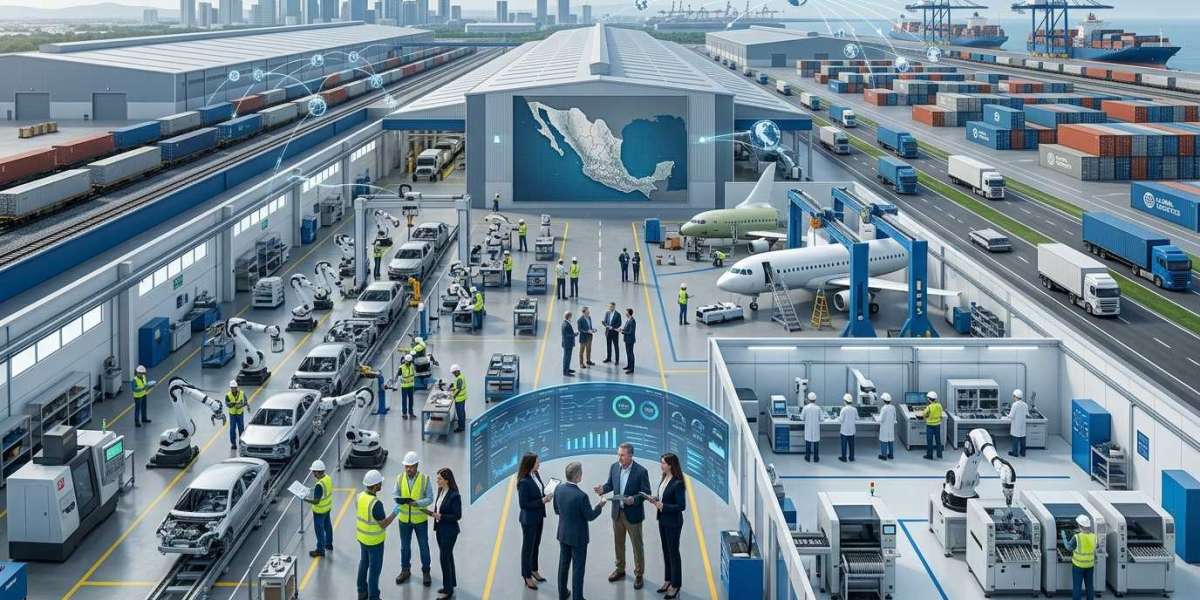

In 2023, Mexico did something it hadn't done in over two decades — it became the United States' single largest source of imports, edging out China entirely. That shift wasn't a fluke or a temporary blip. By 2024, Mexico's trade with the U.S. had grown to $466.6 billion, representing roughly 15.6% of all American imports.
For international buyers trying to decide where to manufacture next, that number tells an important story: Mexico isn't an emerging alternative to traditional offshoring anymore. It's already the dominant one.
But understanding Mexico's manufacturing industry means going deeper than headline trade figures. It means understanding which regions specialize in what, how trade policy is shifting in real time, what's driving the current wave of investment, and where the genuine risks sit alongside the very real opportunities. This guide walks through all of it, built for buyers who want the full picture before making a sourcing decision.
In this guide, you will learn:
- Why Mexico has become North America's dominant manufacturing hub
- The industries and regions driving the country's manufacturing growth
- How USMCA and current trade policy shape the opportunity
- Common misconceptions buyers have about manufacturing in Mexico
- A real-world example of a company navigating the shift successfully
- Practical tips for approaching Mexico's manufacturing landscape strategically
Why Mexico's Manufacturing Sector Has Grown So Quickly
The forces behind Mexico's manufacturing boom aren't accidental. They're the product of geography, policy, and a global supply chain realignment that's been building for several years.
Proximity and logistics advantage
Manufacturing in Mexico allows companies to ship finished goods to the U.S. by truck in a matter of days rather than the several weeks typically required for ocean freight from Asia. Moving production to Mexico cuts transit time from 25 to 40 days by ocean down to just 2 to 5 days by truck, while also reducing the working capital tied up in inventory. For companies managing seasonal demand or fast-moving product cycles, that speed advantage alone can be transformative.
Labor cost differential
Despite rising wages in parts of the country, Mexico still offers a substantial labor cost advantage. Fully loaded manufacturing labor costs in Mexico average around $6.51 per hour, compared to $31.59 to $32.27 per hour in the United States, translating into 75 to 80% savings on assembly-intensive operations.
USMCA trade preferences
The United States-Mexico-Canada Agreement gives compliant Mexican exports preferential, often duty-free, access to the U.S. market. By mid-2025, 77% of Mexican imports into the United States qualified for duty-free treatment under USMCA, up sharply from just 42% in the agreement's earlier years. That shift reflects both stronger compliance efforts by manufacturers and a growing incentive to qualify as tariffs on non-compliant goods and competing regions have risen.
Diversification away from China
A meaningful share of Mexico's manufacturing growth reflects companies actively diversifying supply chains away from China. IMF estimates suggest that between 2017 and 2023, roughly $70 billion — about 45% — of Mexico's export gains were directly attributable to U.S. tariffs on Chinese goods.
Actionable Takeaway: Don't view Mexico as simply a "cheaper alternative" to Asia. The combination of logistics speed, trade preference, and labor cost creates a fundamentally different cost and risk profile — one worth modeling on its own terms rather than as a straight substitution.
Key Industries Driving Mexico's Manufacturing Growth
Mexico's manufacturing base isn't uniform. Different industries have developed real depth and specialization in different parts of the country.
Automotive
Automotive remains Mexico's largest and most established manufacturing sector. The country produced nearly 4 million vehicles in 2024, with the automotive sector accounting for 31.4% of Mexico's total exports, valued at $193.9 billion.
Electronics
Electronics manufacturing is scaling rapidly as companies nearshore semiconductor and telecom production. Mexico's electronics manufacturing services market is projected to grow from $53.2 billion in 2025 to $97.4 billion by 2031, driven substantially by nearshoring of semiconductors and telecom equipment.
Aerospace
Mexican aerospace exports reached $10 billion in 2024, concentrated primarily in Querétaro and Chihuahua, cementing the country's position as a key node in North America's aerospace supply chain.
Medical devices
Medical device manufacturing has grown steadily, aided by a meaningful labor cost advantage even compared to other low-cost manufacturing regions. Industry benchmarks place Mexican medical device labor costs at roughly $4.90 per hour, compared to approximately $6.50 per hour in China.
Beyond the traditional sectors
Growth isn't limited to Mexico's historically dominant industries. Non-automotive manufacturing exports grew 12.25% cumulatively through 2025, reaching 62% of total exports by August — the highest share since 2009.
Industry | Key Growth Indicator | Primary Regions |
Automotive | ~4M vehicles produced in 2024; 31.4% of exports | Bajío, Nuevo León |
Electronics | Projected to nearly double to $97.4B by 2031 | Guadalajara, Baja California |
Aerospace | $10B in exports in 2024 | Querétaro, Chihuahua |
Medical devices | Lower labor cost than China benchmarks | Tijuana, Baja California |
Actionable Takeaway: Prioritize regions with proven depth in your specific industry rather than choosing based on overall popularity or general investment headlines. Cluster specialization tends to translate directly into workforce skill and supplier network quality.
Where Manufacturing Concentrates Geographically
Mexico's manufacturing activity isn't evenly distributed. In the first quarter of 2025, Chihuahua, Coahuila, Nuevo León, Baja California, and Tamaulipas together accounted for over half of Mexico's total manufacturing exports, reflecting the strategic advantage of proximity to the U.S. border for logistics and shipping times.
That said, inland hubs like Querétaro and Guadalajara have carved out their own specialized strengths, particularly in aerospace, electronics, and advanced manufacturing, often supported by strong technical talent pools rather than pure border proximity.
Understanding the Current Trade Policy Landscape
This is the area buyers most often misunderstand, and it's shifting quickly enough that outdated assumptions can lead to costly mistakes.
The 2026 USMCA review
The USMCA undergoes its first formal joint review in July 2026, assessing whether the agreement should be extended for another 16 years. This is not a full renegotiation, but the outcome will influence future investment flows and trade dynamics across the region.
Rising USMCA compliance
Manufacturers have responded to tariff pressure by significantly increasing formal USMCA compliance. USMCA utilization among qualifying trade rose from around 45% before March 2025 to approximately 89% by November 2025, as companies invested heavily in the documentation and rules-of-origin work required to qualify for preferential treatment.
Tariff volatility
Trade policy has shifted meaningfully in a short period. In February 2026, the U.S. Supreme Court struck down a 25% tariff that had been applied to Mexican imports under emergency economic powers, after which the administration introduced a 10% surcharge under a different legal authority for non-USMCA-qualifying goods.
Actionable Takeaway: Build a rules-of-origin audit into your sourcing strategy now, regardless of your current qualification status. Trade policy is moving quickly enough that even qualifying operations should regularly reconfirm their compliance position.
Common Misconceptions About Manufacturing in Mexico
- "Mexico is only good for low-skill assembly work." In reality, aerospace, medical devices, and advanced electronics all involve highly technical, precision manufacturing carried out at a serious scale.
- "It's basically the same as manufacturing in China, just closer." The cost structure, regulatory relationship with the U.S., and logistics model are fundamentally different, not just geographically adjusted.
- "Trade policy uncertainty means now is a bad time to commit." Most experienced nearshoring advisors view the current environment as a reason to move deliberately and strategically, not to delay entirely, since infrastructure and industrial space are tightening as demand grows.
- "All regions in Mexico offer roughly the same advantages." Regional specialization is significant, and choosing a location without matching it to your industry's cluster strengths often leads to a steeper, costlier ramp-up.
- "Security concerns make Mexico manufacturing inherently risky." Security is a real and legitimate operational cost to plan for, not a reason to avoid the region entirely — most established manufacturers build it directly into their operating budgets.
Ignoring these realities doesn't just create inefficiency — it often leads companies to choose the wrong region, underestimate compliance requirements, or misjudge the true cost structure of their operation before it even gets off the ground.
Real-World Example: Adapting to a Shifting Landscape
A mid-size consumer electronics company began exploring Mexico manufacturing in 2023, drawn primarily by rising costs and tariff exposure tied to its existing China-based supply chain. Initial due diligence focused heavily on labor cost comparisons, without much attention paid to USMCA rules-of-origin requirements.
As tariff policy shifted through 2025, the company's operations team realized that simply manufacturing in Mexico wouldn't automatically secure duty-free treatment unless a sufficient percentage of components met regional content thresholds. Several key components were still being sourced from outside North America, putting the operation's USMCA qualification at risk.
Rather than treating this as a minor compliance detail, the company invested in mapping its entire component sourcing chain and worked with regional suppliers to replace several previously offshore components with USMCA-qualifying alternatives. By the time formal review discussions intensified in 2026, the company's operation was fully compliant and insulated from the surcharges affecting less-prepared competitors.
The lesson wasn't that manufacturing in Mexico was inherently complicated — it was that treating trade policy as a background detail rather than a core strategic input nearly cost the company its competitive advantage.
Reactive vs. Strategic Approaches to Mexico Manufacturing
Approach | Characteristics | Typical Outcome |
Reactive | Moves production for cost savings alone, treats compliance as an afterthought | Exposure to tariff surprises, slower adaptation to policy shifts |
Strategic | Integrates USMCA compliance, regional specialization, and infrastructure planning from the start | Stronger cost stability, faster response to policy changes |
Expert Tips for Approaching Mexico's Manufacturing Landscape
- Treat USMCA compliance as an ongoing process, not a one-time qualification check, especially with the 2026 review introducing potential changes to rules of origin.
- Factor security costs into your budget from the start. Experienced operators typically allocate a meaningful percentage of annual budgets specifically toward protecting facilities and personnel.
- Move on infrastructure decisions earlier rather than later. Industrial space in major hubs is tightening as demand grows, and delaying site selection often means facing higher costs later.
- Build workforce development into your long-term plan. Specialized, bilingual technical talent is increasingly the limiting factor for scaling operations, not available capital.
- Stay closely engaged with trade policy developments through credible sources rather than relying on outdated assumptions from even a year or two ago, given how quickly the landscape continues to shift.
Frequently Asked Questions
Why has Mexico become the top manufacturing destination for U.S.-bound production? A combination of geographic proximity, USMCA trade preferences, competitive labor costs, and global supply chain diversification away from China has positioned Mexico as North America's primary nearshoring destination.
What's the difference between nearshoring and reshoring? Nearshoring means shifting production to a nearby country like Mexico to retain much of the cost advantage of offshore manufacturing while reducing transit time and tariff exposure. Reshoring means bringing production entirely back to the home country, which typically increases costs significantly.
How does the 2026 USMCA review affect manufacturers already operating in Mexico? The review could influence rules of origin and compliance requirements going forward, making it important for current operators to audit their supply chains and confirm continued qualification under any resulting changes.
Which industries are seeing the strongest manufacturing growth in Mexico? Automotive remains the largest sector, but electronics, aerospace, and medical devices are all experiencing significant growth, alongside broader diversification beyond Mexico's traditionally dominant industries.
Is manufacturing in Mexico more expensive than it used to be? Wages and industrial real estate costs have risen in high-demand corridors as competition for space and talent increases, but Mexico generally retains a substantial cost advantage over U.S.-based manufacturing.
Final Thoughts
Mexico's manufacturing industry isn't a temporary trend riding on short-term tariff dynamics — it reflects a deeper structural shift in how North American supply chains are built. Buyers who understand the regional specializations, trade policy nuances, and genuine risks involved are positioned to make far stronger sourcing decisions than those chasing headline cost savings alone.
If you're evaluating Mexico for the first time, working with an experienced nearshoring consultant or manufacturing advisor can help translate this landscape into a strategy specific to your product and industry. The opportunity is real, but capturing it fully takes more than good timing — it takes a clear, informed approach from the very beginning.