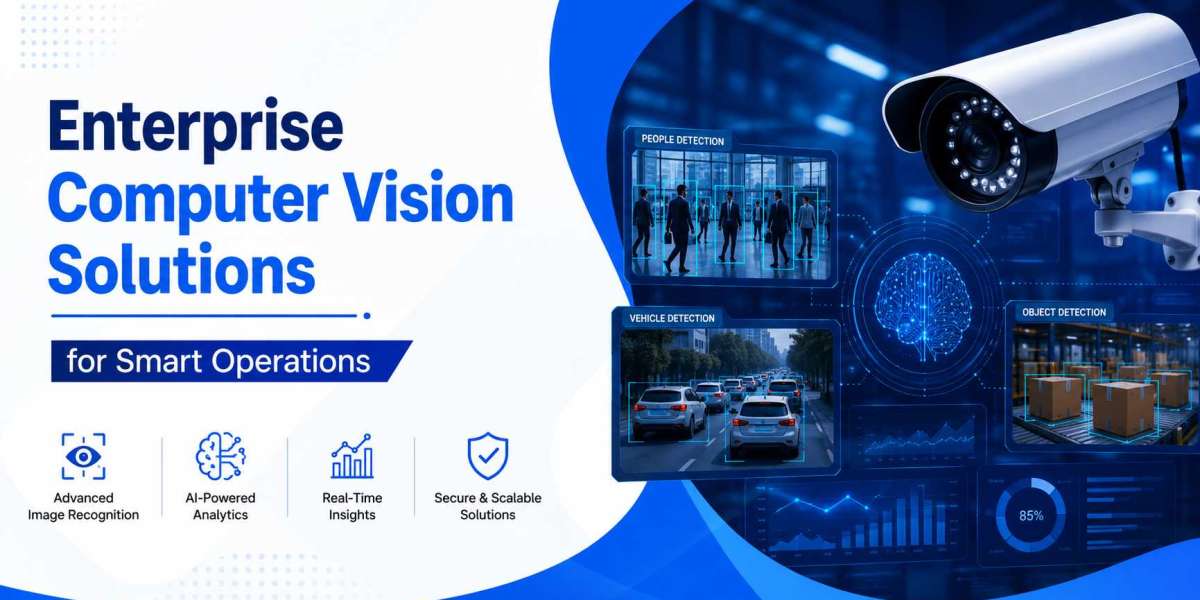

Walk into any modern warehouse, factory floor, or retail chain today, and you'll notice something different from five years ago — cameras aren't just recording anymore, they're thinking. That shift is what's driving enterprise leaders toward computer vision, and it's no longer a nice-to-have experiment tucked away in an RD lab. Business owners across manufacturing, logistics, healthcare, and retail are now treating visual intelligence as core infrastructure, the same way they once treated ERP systems or cloud storage. The reason is simple: cameras paired with the right algorithms can spot defects, track inventory, monitor safety compliance, and flag anomalies faster and more consistently than any human team working round the clock ever could.
What makes this moment particularly interesting is the maturity of the underlying technology. Five years ago, deploying vision systems meant massive upfront investment, custom hardware, and a small army of data scientists. Today, cloud infrastructure, pretrained models, and edge computing have brought the cost and complexity down dramatically, which is exactly why mid-sized enterprises — not just tech giants — are now exploring computer vision development services to solve operational headaches that used to feel unsolvable.
Why Smart Operations Need Computer Vision Now
Operations teams have always relied on data to make decisions, but most of that data has historically come from sensors, spreadsheets, and manual checklists. Cameras change the equation entirely because they capture context that numbers alone can't — the exact position of a misaligned part, the way a worker moves near heavy machinery, the subtle color shift in produce that signals spoilage. This visual layer of data has been sitting there, mostly untapped, for decades. What's changed is the ability to actually process it at scale, in real time, without needing a human to watch every single frame.
The pressure to modernize is also coming from the bottom line. Downtime, quality escapes, and safety incidents are expensive, and traditional monitoring methods simply can't catch problems fast enough. Vision-based systems close that gap by working continuously and flagging issues the moment they appear rather than during a scheduled audit days later.
- Reduced reliance on manual inspection, which is slow, inconsistent, and prone to fatigue-driven errors
- Faster detection of equipment wear, misalignment, or failure before it causes a full shutdown
- Real-time visibility into worker safety compliance, such as PPE usage or restricted-zone entry
- Better inventory accuracy through automated shelf and warehouse monitoring
- Data-driven insights that feed directly into predictive maintenance and demand forecasting models
Core Use Cases Reshaping Enterprise Operations
Every industry has its own pain points, but the pattern across sectors is remarkably consistent: vision systems are being used to replace repetitive human observation with automated, always-on monitoring. In manufacturing, that might mean catching a hairline crack on a circuit board that the human eye would miss nine times out of ten. In logistics, it might mean confirming that every package on a conveyor belt is scanned, sorted, and routed correctly without a single missed item. In retail, it could be as simple as knowing exactly when a shelf needs restocking without sending someone to physically check.
These aren't hypothetical scenarios anymore — they're active deployments generating measurable ROI. What ties them together is that each use case started as a narrow, well-defined problem before expanding into a broader operational capability once the initial results proved out.
- Quality inspection: Automated defect detection on production lines, reducing scrap rates and rework costs
- Warehouse and inventory management: Real-time stock counting, shelf monitoring, and misplaced-item detection
- Worker safety monitoring: PPE compliance checks, fall detection, and restricted-area alerts
- Predictive maintenance: Visual anomaly detection on machinery to flag wear before failure occurs
- Retail analytics: Foot traffic patterns, planogram compliance, and checkout-free shopping experiences
- Logistics and supply chain: Automated package sorting, container damage assessment, and loading dock monitoring
Building vs. Buying: Why Custom Development Matters
Off-the-shelf vision tools can handle generic tasks reasonably well, but enterprise operations rarely fit into a generic mold. A pharmaceutical packaging line has different visual requirements than a steel mill, and a grocery chain's shelf-monitoring needs look nothing like a construction site's safety compliance system. This is where the difference between a pre-packaged tool and genuine computer vision software development becomes obvious — one gives you a template, the other gives you a system built around your actual floor plan, your actual products, and your actual failure modes.
Custom development also matters because operational environments change. Product lines get updated, lighting conditions shift, new equipment gets introduced, and a system that isn't built to adapt will start producing false positives or missing real issues within months. Working with a capable computer vision development company means the solution is designed with that evolution in mind from day one, not bolted on as an afterthought once the original model starts drifting.
- Tailored model training on your specific facility, products, and edge cases rather than generic datasets
- Seamless integration with existing ERP, MES, or IoT infrastructure instead of operating as an isolated tool
- Scalability built in from the start, so the system grows with additional camera feeds or locations
- Ongoing model retraining and support to handle drift as operational conditions change over time
- Clear ownership of the system's data and logic, avoiding vendor lock-in that limits future flexibility
What to Look for in a Development Partner
Choosing the right partner is arguably a bigger decision than choosing the technology itself, because even the best algorithms fail if they're implemented without a real understanding of your operational context. A strong computer vision development company doesn't just write code — it spends time understanding your bottlenecks, your compliance requirements, and the practical constraints of your physical environment before proposing a single line of architecture. That discovery phase often separates a system that gets used daily from one that gets quietly abandoned after a few months.
It also helps to look at how a vendor has handled deployment at scale, not just in a proof-of-concept demo. A pilot running on ten cameras in a controlled test environment behaves very differently once it's expanded to two hundred cameras across multiple facilities with inconsistent lighting and network conditions. The partner you choose should have a track record of managing that transition without the system falling apart under real-world variability.
- Proven experience deploying vision systems across similar industries or operational environments
- Transparent communication about model limitations, accuracy rates, and expected edge cases
- A clear plan for data privacy, security, and compliance, especially in regulated industries
- Post-deployment support, including retraining, monitoring, and performance tuning
- Flexibility to work with your existing tech stack rather than forcing a full infrastructure overhaul
The Case for In-House Talent
While outsourcing to a specialized firm is often the fastest path to deployment, many enterprises eventually reach a point where they want direct control over their vision infrastructure — particularly if computer vision becomes central to how the business operates rather than a single-use project. This is when leadership starts to seriously consider whether to hire computer vision developers as part of a permanent internal team, rather than continuing to rely entirely on external vendors for every iteration and update.
The trade-off is fairly straightforward. Building an internal team gives you tighter control, faster iteration cycles, and institutional knowledge that stays within the company rather than walking out the door when a contract ends. But it also requires sustained investment in talent that's currently in high demand and short supply, along with the infrastructure to support ongoing model development and maintenance. Many enterprises land on a hybrid approach — partnering with an external firm for initial development and complex model architecture, while gradually building internal capacity for day-to-day monitoring and smaller iterative improvements.
- Faster response time for troubleshooting and system adjustments without waiting on external vendor cycles
- Deeper institutional knowledge of your specific operational quirks and historical data patterns
- Greater long-term cost efficiency once the system reaches a certain scale and update frequency
- Direct alignment between engineering priorities and evolving business goals
Getting Started Without Overcommitting
The biggest mistake enterprises make when adopting computer vision isn't choosing the wrong technology — it's trying to solve every operational problem at once. A far more sustainable approach is to start with a single, well-defined use case where success can be measured clearly, whether that's defect detection on one production line or safety monitoring in one warehouse zone. Once that pilot proves its value, expanding to additional use cases becomes a matter of scaling proven architecture rather than starting from scratch every time.
This measured approach also makes it easier to evaluate whether your current vendor relationship is the right long-term fit, or whether the project has grown to a point where deeper computer vision software development company involvement — or an internal hiring push — makes more sense. Either path works, but the decision should be driven by how the pilot actually performs, not by assumptions made before a single camera was ever installed.
- Start with one measurable, high-impact use case before expanding to facility-wide deployment
- Set clear success metrics upfront, such as defect detection accuracy or reduction in inspection time
- Build in a feedback loop so the system improves based on real operational data, not just initial training
- Reassess vendor or in-house strategy once the pilot delivers concrete, measurable results
Final Thoughts
Computer vision has moved well past the experimental phase for enterprise operations — it's now a practical, measurable way to cut costs, reduce risk, and catch problems before they escalate into bigger ones. The businesses seeing the strongest results aren't necessarily the ones with the biggest budgets; they're the ones who started with a focused problem, chose the right development partner, and built systems designed to evolve alongside their operations. Whether that means engaging computer vision development services for a targeted pilot or eventually building an internal team, the path forward starts with a clear understanding of the specific operational problem you're trying to solve — the technology decisions tend to fall into place once that's settled.