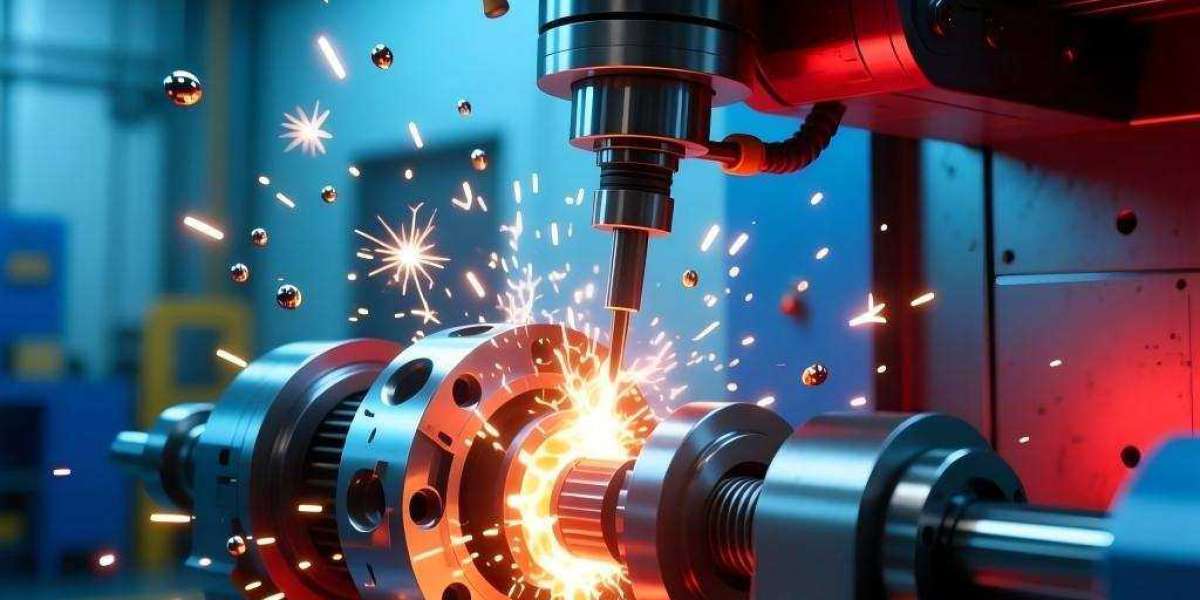

Custom CNC turning parts are essential whenever a design includes round geometry, symmetry, threads, grooves, bores, or other cylindrical features. While many parts begin as rough ideas in CAD, turned components often become the functional core of the assembly because they control alignment, fit, rotation, and fastener interfaces. JRT Machine’s CNC turning service page emphasizes that turning is especially suitable for round or cylindrical parts and can also support operations such as drilling, boring, threading, and knurling. That combination makes turning one of the most dependable processes for precision part production.
The reason turning remains so important is that rotational symmetry naturally fits many mechanical systems. Shafts, pins, spacers, bushings, connectors, threaded adapters, and motor-related components all depend on concentric geometry. If the centerline is off, the assembly may vibrate, wear quickly, or fail to fit. A custom CNC turning parts supplier helps control those risks by making the part on equipment designed for that geometry. JRT Machine’s site also shows examples such as stainless steel pins with thread, aluminum turning parts, and precision turned components, which indicates that turning is used not only for basic cylinders but for more demanding engineering designs as well.
For buyers, one of the biggest benefits of CNC turning is repeatability. Once the program and setup are established, the machine can produce the same profile consistently across batches. That matters in production environments where even small dimensional drift can affect assembly. JRT Machine states a standard dimensional tolerance of ±0.005 mm for CNC manufactured parts, which is especially relevant for turning jobs that require close fit and stable concentricity. In practical terms, that level of control helps reduce post-machining adjustment and makes final assembly more efficient.
Material choice is another major factor in custom CNC turning parts. JRT Machine works with aluminum, stainless steel, brass, and plastics, and its site also shows examples in materials such as Al6061-T6, Al7075, SS304, and brass. These material options matter because the final part must match its environment. Aluminum is often chosen for lightweight structures, stainless steel for durability or corrosion resistance, brass for machinability and appearance, and plastics for lower weight or insulation needs. A good turning supplier does not simply machine the part; it helps select a material that supports both function and manufacturability.
Surface finishing is also part of turning quality. JRT Machine lists finishing options such as smooth finish and powder coating on the turning page, and the wider site shows finishing support as part of the one-stop service model. That matters because a turned part is often not finished when it leaves the machine. It may require deburring, polishing, coating, or other treatment depending on its use. By offering finishing support, a supplier reduces the amount of work the customer must coordinate after machining. This is particularly valuable when the part is part of a larger assembly with strict appearance or wear requirements.
Custom CNC turning parts are also important because they can be integrated into broader production strategies. A project may start with a turned prototype, move into a milled-and-turned hybrid component, and later scale to batch production. JRT Machine’s service structure supports that kind of growth because it combines rapid prototyping, precision machining, and mass manufacturing under one supplier model. For engineering teams, that continuity reduces the chance that a successful prototype becomes difficult to reproduce later. In this sense, custom CNC turning parts are not just a machining category. They are a reliable way to build mechanical consistency into the product from the start.