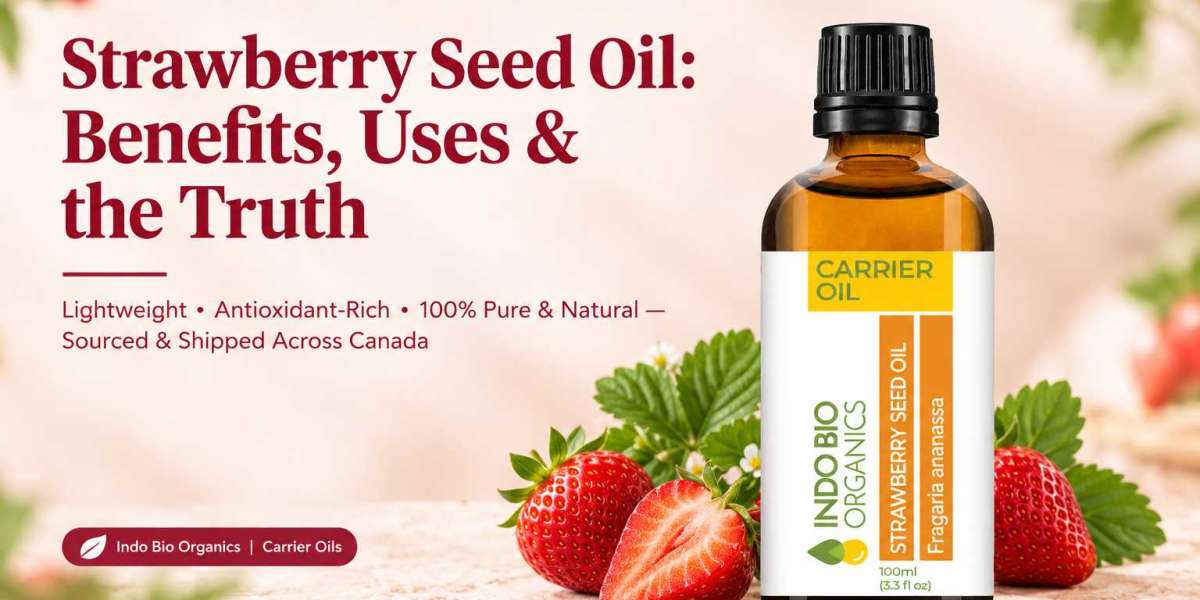

Strawberry Seed Oil: Benefits, Uses, and the Truth About "Strawberry Essential Oil"
Search for "strawberry essential oil" and you'll find plenty of products using that exact name. Here's the problem: it doesn't technically exist, at least not the way lavender or peppermint essential oil does. Strawberries simply don't contain enough volatile aromatic compounds for steam distillation — the process used to make a true essential oil — to yield anything meaningful. What's actually sold under that name is one of two things: genuine cold-pressed strawberry seed oil (a carrier oil, chemically and functionally different from an essential oil), or a synthetic fragrance oil engineered to smell like strawberries, with no connection to the actual fruit's chemistry at all.
This matters because it changes what you should expect from the product. This guide covers what strawberry seed oil genuinely is, its real, well-supported skincare benefits, and how to use it properly — written for Canadian buyers who deserve an accurate label, not just a pleasant-sounding one.
There's No Such Thing as True Strawberry Essential Oil — Here's Why
Essential oils are extracted through steam distillation, a process that works by capturing a plant's volatile aromatic compounds as they evaporate with steam and then condense back into liquid form. This process works beautifully for plants like lavender, peppermint, and citrus peels, which contain significant concentrations of these volatile compounds in dedicated oil glands or cells.
Strawberries don't have this. Their characteristic sweet scent comes from a complex mix of compounds, but not in concentrations or forms that survive or justify steam distillation at any commercial scale. This is a genuinely well-established point among essential oil formulators and aromatherapists, even though it rarely makes it into consumer-facing product descriptions. If you see "strawberry essential oil" marketed as a true distilled oil, it's worth asking the seller directly what process was actually used to produce it.
What Strawberry Seed Oil Actually Is
The real, legitimate product behind most of this naming confusion is strawberry seed oil — cold-pressed from the tiny seeds (technically called achenes) that stud the outside of a strawberry. This is a genuine carrier oil, produced mechanically without heat or chemical solvents in a quality cold-pressed version, retaining the seeds' natural fatty acids, vitamins, and antioxidant compounds. It carries a light, slightly fruity, nutty aroma — pleasant, but notably more subtle than the bright, candy-like strawberry scent most people associate with the name, which is usually the telltale sign of an added synthetic fragrance rather than the oil's natural character.
A Byproduct With a Genuinely Good Sustainability Story
Strawberry seed oil has a practical origin story worth knowing: it's typically produced as a byproduct of the strawberry juice and jam industries, where the seeds are separated out during processing and would otherwise go to waste. Rather than being grown and harvested specifically for oil production, the seeds used are essentially a secondary resource recovered from food manufacturing already happening at scale — a genuinely efficient, low-waste production model compared to oils that require dedicated crop cultivation.
What's Actually Inside the Bottle
Strawberry seed oil's fatty acid profile is notably rich in alpha-linolenic acid (omega-3), commonly cited in the range of 25–38%, alongside substantial linoleic acid (omega-6, roughly 35–50%) and smaller amounts of oleic acid (omega-9) — a genuinely well-rounded essential fatty acid profile. Beyond fatty acids, the oil contains tocopherols (vitamin E), carotenoids (contributing to vitamin A activity), phytosterols, and ellagic acid, a polyphenol specifically associated with strawberries and several other berries, which research has studied for antioxidant and anti-inflammatory properties. Some additional research into ellagic acid's broader health properties is ongoing and includes early-stage, lab-based investigation into other potential effects — worth noting as an active area of study rather than an established skincare claim.
What Strawberry Seed Oil Is Genuinely Used For
Lightweight Hydration for All Skin Types
Thanks to its fast-absorbing, non-greasy texture, strawberry seed oil is commonly recommended across skin types, including oily and combination skin that might find heavier oils too occlusive.
Antioxidant Protection Against Visible Aging
The combination of vitamin E, ellagic acid, and other polyphenols gives strawberry seed oil a genuine antioxidant reputation, commonly used to help counter the visible effects of everyday environmental exposure on skin.
Supporting an Even, Brighter-Looking Complexion
Strawberry seed oil's antioxidant profile is frequently associated with supporting a more even, brighter-looking skin tone over consistent use, making it a popular addition to complexion-focused facial oil blends.
Hair and Scalp Conditioning
Its lightweight, nourishing properties make strawberry seed oil a reasonable addition to hair masks and scalp treatments, valued for softening and conditioning without weighing hair down.
Lip Care and Delicate Skin
Because of its gentle, lightweight nature, strawberry seed oil is a popular ingredient in natural lip balms and products formulated for delicate or sensitive areas of skin.
Why This Fits a Canadian Routine Year-Round
Strawberry seed oil's lightweight texture makes it a practical, non-heavy option through a Canadian summer, when richer oils can feel too occlusive in humid weather, while its genuine nutrient density still offers real support during winter's drier stretches layered under a heavier moisturizer. It's a reasonably versatile, season-agnostic carrier oil compared to some of the heavier options better reserved specifically for deep winter use.
How to Actually Use Strawberry Seed Oil
As a Daily Facial Moisturizer
Apply a small amount directly to clean, slightly damp skin, either alone or blended into your regular moisturizer for an added nourishing, antioxidant boost.
In a DIY Lip Balm
Combine strawberry seed oil with beeswax and a butter like shea for a simple, nourishing homemade lip balm, taking advantage of the oil's gentle, lightweight character.
Blended Into a Hair Mask
Add a tablespoon to your regular hair mask, or apply a small amount directly to dry ends for added shine and softness.
In a Body Oil Blend
Combine with a lighter carrier oil for an everyday body oil that absorbs quickly without feeling heavy.
Getting the Ratios Right
Strawberry seed oil is a finished carrier oil and doesn't require essential-oil-style dilution math:
- Facial or body use: apply directly, undiluted, in the amount needed
- Lip balm formulation: typically used at 10–30% of a balm's total oil phase, alongside waxes and butters
- Blending with essential oils: standard 1–2% dilution — roughly 1–2 drops of essential oil per teaspoon of strawberry seed oil
- Storage: keep in a cool, dark place; refrigeration can help extend shelf life given its polyunsaturated fat content
What Pairs Well With Strawberry Seed Oil
Strawberry seed oil's light, slightly fruity-nutty profile blends well with:
- Rosehip Oil — for an added boost to complexion- and tone-focused skincare
- Jojoba Oil — for an especially lightweight, fast-absorbing combination
- Vitamin E Oil — reinforces the antioxidant profile and helps extend shelf life
- Lavender Oil — for a calming scent addition to a DIY facial blend
- Geranium Oil — for a balancing, skin-toning combination
What to Check Before You Buy
- Labelled accurately as "seed oil," not "essential oil" — a seller using accurate terminology is generally a good sign of overall product transparency
- Extraction method noted: cold-pressed, unrefined is generally preferred for retaining the oil's full nutrient profile
- Byproduct sourcing disclosed: many reputable suppliers specifically highlight the juice/jam industry byproduct origin as a quality and sustainability marker
- No added synthetic fragrance: a genuinely pure product should have a subtle, natural aroma rather than an intense, candy-like strawberry scent
- Color and consistency described: genuine strawberry seed oil is typically green to dark green, not red or pink — a red-tinted product may indicate added coloring
Who Should Be Cautious
- Anyone with a known berry allergy — patch test before broader use, though reactions to the seed oil specifically are uncommon
- Pregnant or breastfeeding individuals — generally considered safe for topical use, but check with a healthcare provider regarding any new skincare addition
- Anyone expecting a strong strawberry scent — genuine, pure strawberry seed oil has a subtle aroma; an intensely fruity "strawberry oil" product is more likely to contain added fragrance
- Anyone with very sensitive skin — patch test before broader use, as with any new carrier oil
Questions People Actually Ask
Is strawberry essential oil real? Not in the traditional, steam-distilled sense that applies to oils like lavender or peppermint — strawberries don't contain enough volatile aromatic compounds for that process. What's genuinely available is cold-pressed strawberry seed oil (a carrier oil) or a synthetic fragrance oil; always check which one a specific product actually is.
Why does my strawberry seed oil smell so mild compared to a fresh strawberry? That's actually a good sign of authenticity. Genuine, pure strawberry seed oil has a light, subtle, slightly fruity-nutty aroma — nothing close to the bright, candy-like scent of a fresh strawberry. A much stronger scent usually indicates added synthetic fragrance.
Is strawberry seed oil good for oily skin? Yes — its lightweight, fast-absorbing, non-greasy texture makes it a reasonable option even for oily or combination skin types, though as always, individual skin response varies.
What does ellagic acid actually do for skin? It's a polyphenol antioxidant studied for its role in neutralizing free radicals and supporting skin's resilience against everyday environmental stress. Some additional research into ellagic acid is ongoing in other areas, but its established, well-supported use in skincare is specifically as an antioxidant ingredient.
Where can I buy pure strawberry seed oil in Canada? Indo Bio Organics carries strawberry seed oil within its Carrier Oils collection, shipped from within Canada, alongside complementary oils for building your own lightweight facial or hair care blend.
Where This Leaves You
Strawberry seed oil earns its popularity honestly — a genuinely lightweight, nutrient-rich carrier oil with a legitimately good sustainability story, sourced from seeds that would otherwise be discarded during juice and jam production. It just doesn't need an inflated "essential oil" label to make that case. Knowing the difference helps you shop more accurately, and sets the right expectations for what a bottle should actually smell and feel like when it arrives.
Explore strawberry seed and other natural carrier oils shipped across Canada from Indo Bio Organics.