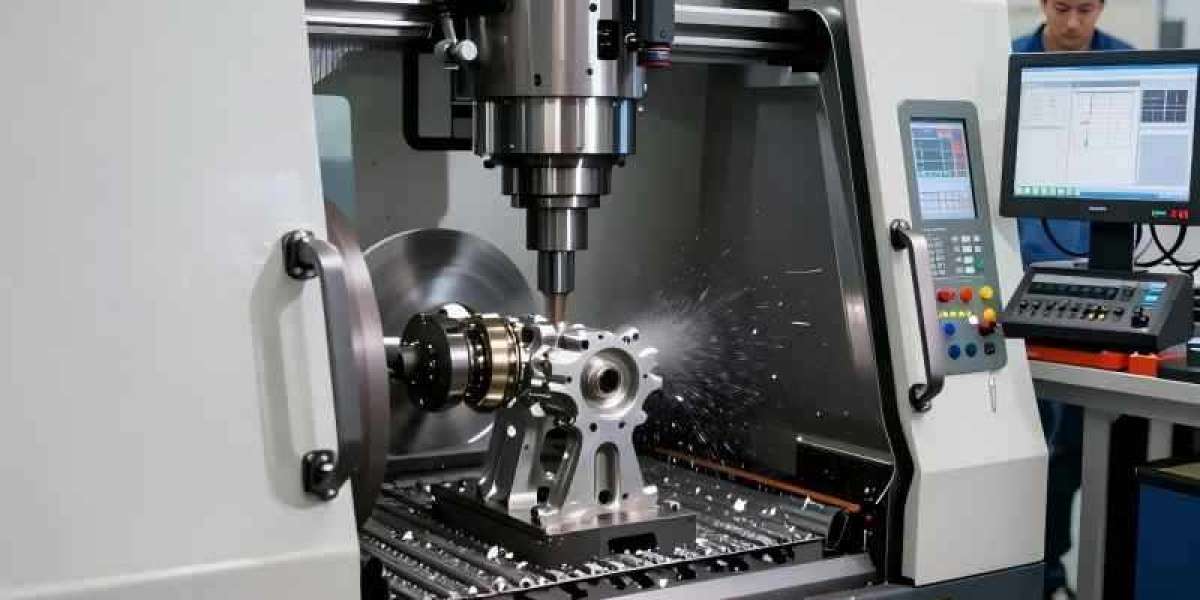

CNC milling is one of the most widely used manufacturing processes in the world – and also one of the most misunderstood. At its core, milling uses rotary cutting tools that move along multiple axes to remove material from a solid block, turning raw metal or plastic into precise, functional components. Because the tools can approach the workpiece from many angles, milling can produce everything from simple straight cuts to complex free-form geometry. Understanding what a professional China CNC milling service can actually deliver helps product teams set realistic expectations, choose the right material, and avoid expensive design errors.
- The axis ladder: 3-axis, 4-axis, and 5-axis machining
Machining centers are usually described by the number of axes they can move simultaneously. A 3-axis machine moves the tool in X, Y, and Z and handles the majority of prismatic parts. A 4-axis machine adds rotation of the workpiece, enabling features around a cylinder without repositioning. A 5-axis machine indexes or interpolates across two additional rotary axes, allowing complex undercuts, angled features, and sculpted surfaces to be machined in a single setup. JTR Machine operates 3-axis, 4-axis, and 5-axis milling centers, which means that moving from a simple bracket to an intricate housing does not require switching suppliers.
- What a modern China CNC milling service typically offers
A capable milling partner should offer more than machines. Look for a standard dimensional tolerance of ±0.005 mm, a range of more than 30 engineering-grade thermoplastics and metals, and a full palette of surface finishes – clear, black, hard-coat, and colored anodizing; passivation for stainless steel; electroplating; bead blasting for a uniform matte look; powder coating; and laser marking for permanent part identification. Lead times matter too: high-precision milled parts in as fast as 24 hours, and rapid prototyping support that lets you validate a design within days. JTR Machine's China CNC milling service is built around exactly these capabilities, so a single partner can carry a part from first sample to volume production.
- Materials that define the part
Material selection often decides whether a design succeeds. Aluminum grades such as 6061, 6063, 6082, and 7075 offer light weight and good machinability; stainless steels 303, 304, and 316L provide corrosion resistance; alloy steels 4140 and 4340 deliver strength; titanium and copper alloys serve specialized applications; and engineering plastics such as PEEK, PTFE, Delrin, Nylon, Ultem, ABS, and PC cover electrical, thermal, and bearing needs. A broad material library means you are not forced to redesign around what a single shop happens to stock.
- Design limits every engineer should know
Milling is powerful, but it is not unlimited. The most common source of trouble in milled parts is geometry that pushes tools beyond their efficient range – and the most common example is thin walls. CNC machining wall thickness is a classic design-for-manufacturability parameter: a wall that is too thin will deflect under cutting force, vibrate, and fail to hold tolerance. As a general starting point, DFM guidelines recommend approximately 0.8 mm for metal walls and 1.5 mm for plastic walls. In practical production, suppliers usually prefer more conservative ranges: roughly 1.0–1.5 mm for aluminum, 1.5–2.0 mm for carbon and alloy steel, 1.5–2.5 mm for stainless steel, and 2.0–3.0 mm for engineering plastics. Wall height matters just as much as thickness: a 1 mm wall that is 5 mm tall may be perfectly stable, while the same wall 40 mm tall can bend and chatter badly.
- Experience with difficult geometry
Some suppliers can go further than generic guidelines. JTR Machine, for example, has published work on thin-wall aerospace aluminum components with wall thicknesses below 1 mm and depths exceeding 100 mm, where dimensional control depends on carefully sequenced machining and stress management rather than a single aggressive pass. That level of experience matters when your design contains lightweight structures, deep pockets, heat sinks, or other high-aspect-ratio features.
- When to request a DFM review
If your part contains deep pockets, thin ribs, tall unsupported walls, or tight tolerances, ask your milling partner for a design-for-manufacturability review before committing to production. A good review evaluates material, wall height, tooling, workholding, and tolerance together, and often suggests practical improvements such as adding ribs, increasing internal corner radii, or reducing pocket depth.
Conclusion
A China CNC milling service is a powerful ally when you understand both its strengths and its limits. Choose a partner with true multi-axis capability, a broad material range, certified quality, and proven experience with difficult thin-wall geometry. Do that, and you turn a commodity transaction into a genuine engineering partnership that moves your product to market faster.